For the impoverished, family life in Normandy
during the early 1800s was hard. It was a life-style to which families were
accustomed. Church service for the family on Sunday and afternoon Sunday
school for the children was a welcome break from the labours of the week.
However, a chain of events had started within the Church and central Government,
that was to improve the quality of the life of children. For in 1870 the
Government finally took the responsibility for the education of the country
by introducing compulsory education into England.
In the beginning
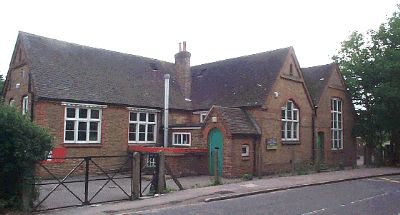
The present building complex, forming the school, has been built mainly
on land acquired in 1862 by Deed of Gift (for a consideration of five shillings),
from H M Chester and F J Chester of Poyle Park. A Trust Deed was executed
in January 1862 with the Vicar and Churchwardens of Wyke and their successors
as trustees for the building of a school and schoolhouse. No provision was
made by the deed for the management of the school. In 1878, The Reverend
Henry Drayton Wyatt made an application to the National Society "for
a building grant towards the erection of a new school, which was to replace
the present school held in a room that was now too small to accommodate
the numbers who wished to attend". The supporting statement indicated
that the room then used was sanctioned for 53 children with a register of
70 wishing to attend. The room was in private property and the agreement,
under which it was held, expired 30 September 1879 and would not be renewed.
The application was approved and a grant of
£45 made towards the new school, designed by Henry Peak (Architect)
and built by W Swayne (Builder) at a cost of £555.9s.9d. Subscriptions
raised from landed proprietors and others fell short of the final cost by
three shillings and three pence, which The Reverend Wyatt was himself obliged
to donate in order to make the books balance. The school was up and running
in October 1879.
The original L shaped school building consisted
of two rooms. The smaller one was for 60 infants, the other for 70 boys
and girls of mixed academic standards. Both rooms had poor natural ventilation
and lighting. In winter, the two rooms were terribly cold, the larger being
heated from a single combustion stove, quite inadequate for the size of
the room. The infants' room, the smaller one, had a fireplace and seating
in fixed gallery formation. In later years, about 1900, the workbenches
of the manual evening classes were stacked in the room during the day. The
gallery was removed in July 1905 and replaced by desks. There were separate
stepped entrances for the boys, girls and infants. Each lobby was used as
a cloakroom. In one, there were three steps and two to each of the others.
The infants often fell on the steps and hurt themselves. Mr P F Story, an
early surveyor of the school, recommended in 1904 a sloped approach to the
entrance lobbies. However, users and visitors to the school over the decades,
will be aware that no such recommendation was ever adopted.
The play areas were separated, but a piece of
ground to one side, covered with gorse and in a very rough state, was used
as a common playground. The school site was enclosed partly by a post and
wire fence, partly by a close-boarded fence and partly by a hedge. It had
practically no drainage at all, so consequently the ground was often flooded
in periods of heavy rain. Fresh drinking water remained a problem until
1905, when the school acquired two four-gallon jars, which the caretaker
had to take each day to fill at Mr J Deedman's well. The caretaker in 1905
received 30/- per week for all his duties.
Copying off the blackboard, working of sums,
taking dictation and reproducing the drawing from the object lesson was
on slates using slate pencils. The latter were often worn to short stubs,
a practice hardly conducive to good writing. Their use was less expensive
than paper. Corrections were easily made and so the practice continued for
many years, but eventually was phased out with the infants being the last
to use slate and slate pencil.
Miss Cecilia White commenced her duties as Headteacher
(Certificated) of Wyke Church of England School on Monday 14 October 1882.
Her predecessor, Miss Sarah Elizabeth White (Uncertificated) was to remain
as Assistant Teacher until December 1883, when she married and sailed with
her husband to India. Miss Davies replaced her in April 1894. Miss Cecilia
White was assisted from time to time by a number of monitresses, older pupils
able to teach the infants, such as Ivy Goddard, Kate Grover and Elizabeth
Bellinger, all of whom were paid two shillings a week. Miss Davies departed
for Puttenham in the August and Miss Billson took her place.
Miss White's headship was short-lived for tragedy
struck on Saturday 17 January 1885 "when she (Miss Cecilia White) met
with a fatal accident on the SE Rail near Ash Junction Station" as
entered in the logbook by The Reverend Henry Wyatt, Chairman of Managers.
The use of logbooks, to note daily happenings,
was introduced into schools in about 1862. It is possible that there was
an earlier one than that started by Miss Cecilia White in 1882. So, for
the time being, earlier headteachers of the school (other than Miss Sarah
White) remain unknown, as do their chronicles. Interestingly, the 1881 census
for the Parish of Ash, Village of Wyke, indicates that the schoolhouse was
occupied by George Marshall (Gardener) and the occupation of his wife was
"schoolmistress".
It is reasonable to presume from Cecilia White's
early recordings that only families living in the immediate area of the
school sent their children to the school. Equally, it may be safe to assume
that the school premises were used for night school pupils as well as day
pupils, since frequent mention is made of "parties for the day pupils
only". Often the school was closed in the afternoon in order to prepare
the larger of the two rooms for an evening concert.
It was not uncommon for the school to close
for long periods on account of diphtheria, measles, whooping cough, scarlet
fever and ringworm. In March 1885, whooping cough and measles was prevalent,
forcing the managers of the school to close it for two weeks. Early in 1891,
scarlet fever raged in the Willey Green area. Families in Bailes Lane were
forbidden to send their children to the school. Sadly, in August, Edith
Northover died of diphtheria and the Medical Officer of Health for the Farnham
District, Dr John A Lorrimer, recommended the closing of the school. In
1893 and again on his instruction the school was closed for three weeks
in May due to another outbreak of diphtheria, in July for a further four
weeks and again in November for six weeks. By 22 January 1894 there had
been 23 cases notified.
Since the greater part of the income of the
school was dependent on government grants based on average attendance figures,
the marking of the daily registers were of paramount importance. A favourite
excuse for being absent a week at a time was for seasonal fruit picking.
In July 1883, children picking currants at Mr Parrott's Nursery, reduced
the daily attendance average for the week from about 90 to 50. No excuse
was needed, however, to close the school for the annual church choir outing
in July of each year. These started in about 1896 and continued until 1914,
possibly then being discontinued because of the outbreak of World War I.
The generosity over the years of local dignitaries
to children of Wyke school has always been appreciated such as that by the
Coussmaker family, Colonel and Mrs Wavell and Lady Bright. Mrs Stevens,
a manager's wife in those early years, presented at Christmas to each girl
a pair of scissors, a knife to every boy in the upper school and two handkerchiefs
to each infant. The Halsey family and Lady Roberts invited the school to
tea parties at Henley Park. Also, Lady Roberts gave a bun and an orange
to each child at Christmas, between 1918 and 1923.
Although and allegedly, Britain was ill prepared
for war in 1939, a scheme of evacuation was tested at the school in September
1937 to see how long it took teachers and pupils to clear the school buildings.
All children were off the premises in 30 seconds. In July 1939, everyone
at the school was instructed to bring their issued gas mask to school for
the first time. The air raid shelters in the school garden were occupied
for the first time in September 1940 and three teams of senior boys were
trained to use stirrup pumps to fight fires. As the years advanced to 1942,
the sound of the air raid warning was generally dreaded whereas the long
continuous wail of "the all clear" was a very welcome sound, although
it could hardly be heard in the shelter. A problem emerged later in 1942
as to how some children could be protected in the daytime during the summer
holiday when parents were away from home on essential war work. In consultation
with the Education Authority and the school managers, Mr Smith arranged
for the school to remain open with attendant teachers on a roster system.
A telephone, Normandy 2197, was installed for the Local ARP (Air Raid Precautions)
to give the teacher early warning of an air raid. Mr Smith complained "that
not only was no warning given by phone, but neither was any message received
by runner from the local ARP post". A shelter remains on the school
site forming part of the south-western boundary.
Normandy had been generally unaffected by enemy
air raids, despite its proximity to Aldershot, the Home of the British Army.
However, on 16 June 1944, five windows of the school were damaged by blast
from enemy action. Although there were other incidents around and about,
life at the school continued undisturbed until cessation of hostilities
in May 1945 when the school was closed for the VE Day (Victory in Europe)
celebrations.
Mr Lewis (Headteacher 1954 - 1971) had a strenuous
career at Wyke, not just as a headteacher but also as an educationalist.
As a result Wyke became, during the 1960s, a visiting post for overseas
visitors and teachers attending county conferences. The school was also
subjected to numerous temporary staff changes and visits by student teachers
from the Gypsy Hill Training College, an extension of the Guildford College,
observing teaching methods. There was yet another change in staff when Margaret
Clegg, Deputy Headteacher, retired in July 1967 after 21 years of dedicated
service to the school. When school reopened after the summer holiday, Mr
Lewis commented that "The same staff continues for the first time since
1959" but changes continued until 1970 when there was a degree of stability
in the permanent teaching staff.
A new classroom was added in February 1963 and
the new assembly hall and kitchen were finally brought into use. It was
25 years previously that hot meals were first provided but now school meals
were cooked on the premises.
In 1972 Wyke became a First School. The change
to the Surrey Education Plan required that those children over 8 years of
age move on to a Middle School. Some schools, such as Perry Hill, Worplesdon
were closed and the pupils transferred to other schools. Fortunately Wyke
was generally unaffected. By 1974, all schools in the county were feeling
the effects of cutbacks in spending on education. Some school buildings,
owing to long overdue maintenance were in a deplorable condition, but Miss
Burrows (Headteacher 1971 - 1994) was determined not to let Wyke's buildings
suffer a similar fate and persuaded her staff and the parents to carry out
essential decoration and renovation.
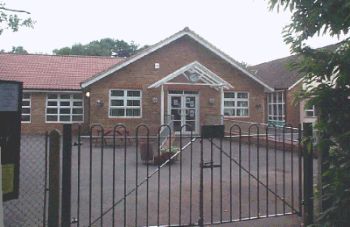
More new buildings came n 1999. These pleasing modern buildings of 1999
have blended well with the original Victorian buildings, providing three
new classrooms and an administration area.
Normandy is fortunate in having enjoyed a village school for over 120
years, a fact now endorsed by the Surrey County Council by providing new
buildings and upgrading the old ones. The school now know as Wyke Primary
School is a fitting reminder of its heritage and is adequately prepared
for the foreseeable future. |