The land given by the Coussmakers for the building
of St. Mark's, Wyke, during a period of national upsurge in church and chapel
construction, enabled work to start in 1846, including the setting out of
a churchyard. A young architect by the name of Henry Woodyer, with an office
in Guildford and related to both the Coussmaker and Halsey families, was
commissioned to design this church for Wyke. St. Mark's was his first venture
into designing and constructing a church having been previously concerned
only with restoration work. He went on to design many other churches in
Surrey and neighbouring counties.
As befits a first foray into church design from
scratch, St. Mark's is an unpretentious building consisting of a chancel,
a north vestry and a nave. It is in the then fashionable Geometric Decorated
or Second Pointed Gothic style and is built of Bargate Stone rubble with
Heath Stone foundations and quoins and Bath Stone dressings. The roofs are
tiled and there is a small bell turret at the west-end. The Coussmaker family
maintained their Memorial chapel and private mortuary, added to the main
building in 1848, until 1962 when the family relinquished the rights of
the chapel to the Parochial Church Council. The Coussmaker monument stands
against the south wall of this chapel. There is also a memorial tablet to
Henry Woodyer's parents, Caleb and Mary Woodyer, nee Halsey. A description
of the interior of the chapel and other details may be found in "Westwood,
the Story of a Surrey Estate".
St. Mark's, Wyke, consecrated in 1847 and obtaining full parish status in
1867, was endowed principally by the Coussmaker and Halsey families and
with contributions from the Incorporated Church Building Fund and the Winchester
Diocesan Fund. The church immediately became the focus of life in Normandy,
as early records of baptisms, marriages and funerals record during the period
when the Reverend W A Paxton travelled from Aldershot to take the services.
The 1851 census gives the number attending services, 105 for the morning
service and 114 in the afternoon, signed by Henry Freeman Cheshire, the
resident Minister who at that time lived with his family in what is now
Wyke Lodge. Although he and his wife went to live in Bath after his retirement
in 1877, both are buried in the old churchyard here at Wyke.
Until Woking Crematorium was opened to the public
in 1886, most people of all faiths in the area around St. Mark's were buried
in the churchyard and a sizable amount of additional land was needed at
that time for future burials. Consequently a quarter acre of land was acquired
from Colonel George Coussmaker and in the 1930s further land was bought
for a new burial ground although a church room was built on part of the
land.
Since 1977 part of the burial ground has been
set aside as a Garden of Remembrance in memory of Cyril Dyson, an active
member of the church and a long serving member of the choir. Today this
garden may be used as a resting-place for the ashes of parishioners. It
is perhaps fitting that the churchyard is now a designated Site of Natural
Conservation Interest in which grass cutting has to be restricted in order
to permit the cowslips, the wild orchid and other plants to prosper.
To commemorate the addition of the burial ground
to the churchyard, Major Leslie Gordon-Alexander, a local resident until
1937, produced a Register of Graves, on which he spent many hours skillfully
documenting, with detailed notes and illustrations, designs uniquely symbolic
to the church. It contains pages of 13th century style decorated borders
with illuminated capital characters. On the front page is the ornate initial
T and it contains the heraldic bearings of Venice, which are representative
of St. Mark, the church's patron saint.
The coats of arms in the border are those of
the successor Patron Bishops of Eton, Winchester and Guildford, and of the
Coussmaker family. The symbol of the daisy, featured in the border, is the
flower of April, representing the month in which the Coussmaker family donated
the land for the building of the church. Three Signs of the Zodiac are set
into the borders. They are Scorpio, referring to the date of the Order in
Council constituting the Parish of Wyke, Taurus the Bull referring to the
Deed of Gift of land by the Coussmakers and Sagittarius the Archer referring
to the 24 November, the date the church was consecrated. This Register of
Graves was entrusted to Miss Emily Booty, organist and choirmistress of
the church for 40 years until 1954, and as a result was referred to over
the years as "Miss Booty's Book". It is a most fascinating book
and a valuable asset of the church.
The organ then was non-electric and the air
reservoir required regular manual pumping in order to maintain a sufficient
volume of air to replace that blown out in producing the musical notes.
It was usual for a boy to be detailed to the task of "pumping the organ".
The two Booty sisters, Emily and Alice, were well known in the village.
Alice, who was lame, often accompanied her more active sister and like her
was a keen chorister and churchgoer. They both lived at The Croft, Glaziers
Lane. Emily and her other sister Mary were co-principals of Denehyrst School,
Guildford.
In the north east corner of the churchyard,
close to the Guildford Road and standing in distinctive isolation, is the
elaborate chest tomb of Henry de Worms, Lord Pirbright of Henley Park, first
Jewish Privy Councillor and one time Leader of the Anglo-Jewish Community,
who died in 1903. In life he had distanced himself from his old religion
when he married a Christian. A representative of King Edward VII attended
the funeral, but the Jewish Community, saddened at the gradually deepened
rift between themselves and Lord Pirbright and shocked further by his Christian
burial, boycotted the service.
The Pirbright Tomb, a Grade II Listed Building,
is nine feet long and about four feet wide and high. It has panelled sides
decorated with Jacobean-style strap work with ribbands and swags of pomegranate.
The top is supported on the chest and eight detached fluted balusters with
Ionic capitals and moulded bases. The Pirbright coat of arms and inscriptions
to Lord and Lady Pirbright, both interred in the tomb, are carved on the
top. The tomb stands on a plinth with ogee moulded edges, which in turn
stands on a two-step slab covering the sealed vault which contains the two
caskets. On the steps around the tomb are placed inscribed tablets commemorating
relatives of Lord Pirbright buried nearby. At the west-end is a small urn
with Greek key and vine swag decoration.
A fascinating glimpse into family life and history
of the past can be gleaned from the memorial tablets and headstones placed
in the churchyard. Apart from the re-occurring family names, the dates of
birth and death, they sometimes provide other oddities about a person. We
can shed a tear for three little Deedmans, William, Thomas and Charles who
all died in the same epidemic in 1881 and are buried together, and be thankful
for modern medicines. Another family tragedy for the Deedmans was the loss
of Susan, Jane and Mary all aged between 23 and 31 and who died in 1907,
the cause of which we may never know be it an epidemic or a tragic accident.
It is no longer so easy to follow the threads
of family life through the church records, which have reflected the trades
of the people of that time, nurserymen, farmers, bricklayers, basket-makers,
sawyers, as well as those who were employed in other occupations in the
service of the large estates. From the turn of the 20th century other occupations
emerged, particularly of those associated with the railway, and of soldiers,
due no doubt to the close proximity of the developing garrison town of Aldershot.
Our present day shifting population and modern
lifestyle will provide future historians with a much wider framework for
research than hitherto. However, a note of some family names in the churchyard,
such as Horne and Deedman will undoubtedly remain familiar to many future
generations when visiting Normandy.
In the church porch a board records the long
and valued association of the Weston family with St. Mark's. Jack Weston,
born in 1906, lived with his parents Henry and Mary Weston in the schoolhouse.
After the death of his father in 1935, Jack took over the duties as verger
and school caretaker previously carried out by his parents. For 50 years
Jack and his wife Ada faithfully carried out the many necessary tasks to
keep the church and its environs in good order.
From about 1898, and in addition to his principal
duties as headteacher of St. Mark's, Wyke School, Arthur Beer was Choirmaster
and Organist at the church, where the choir sang at Morning and Evening
Services every Sunday, dressed in cassock and surplice. The Sunday school
became popular with the children of the village, encouraging them in weekly
religious instruction and hymn singing, the regular attendance to which
was all important if one wanted to go on the annual summer outing or be
invited to the Christmas party and prize giving. Later, for the older child
there was the Girls Friendly Society and for the older generations there
was the Young Wives Group and the Mothers Union. |

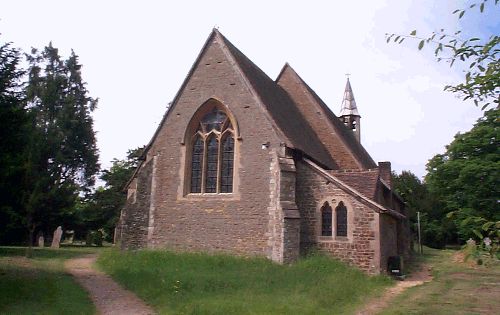
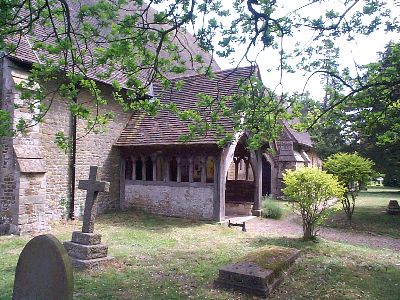 St. Mark's Church, Wyke from the South with the porch