Unknown Sailor
The Unknown Sailor was an anonymous seafarer murdered in September 1786
at Hindhead in Surrey, His murderers were hanged in chains on Gibbet Hill,
Hindhead the following year.
The Unknown Sailor is first recorded as visiting the Red Lion Inn at
Thursley as he was walking back from London to join his ship at Portsmouth
on September 24, 1786. There he met three other seafarers, James Marshall,
Michael Casey and Edward Lonegon. He generously paid for their drinks and
food and was last seen leaving for Hindhead Hill with them. The three seafarers
murdered him and stripped him of his clothes. The three then made their
way down the London to Portsmouth road and were arrested a few hours later
trying to sell the murdered sailor's clothes at the Sun Inn in Rake (not
the Flying Bull in Rake as some versions of the story have it). The
Hampshire Chronicle, dated 2nd October 1786, reads:
|
Sunday last a shocking murder was committed by three sailors, on one
of their companions, a seaman also, between Godalming --- They nearly severed
his head from his body, stripped him quite naked, and threw him into a valley,
where he was providentially discovered, soon after the perpetration of the
horrid crime, by some countrymen corning over Hind Head, who immediately
gave the alarm, when the desperadoes were instantly pursued, and overtaken
at the house of Mr. Adams, the Sun, at Rake. They were properly secured,
and are since lodged in gaol, to take their trials at the next assizes for
the county of Surrey. |
Six months later they were tried at Kingston assizes and two days after
that, on Saturday 7 April 1787, they were hanged in chains on a triple gibbet
close to the scene of the crime in Hindhead.
Gravestone
The unknown sailor was buried in Thursley churchyard and the gravestone
was paid for by the residents of the village. It reads:
In memory of
A generous but unfortunate Sailor
Who was barbarously murder'd on Hindhead
On September 24th 1786
By three Villains
After he had liberally treated them
And promised them his farther assistance
On the road to Portsmouth. |
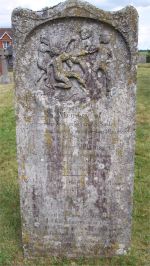 |
The gravestone is a Grade-1 listed structure and has recently been "cleaned
and refreshed".
Sailor's Stone
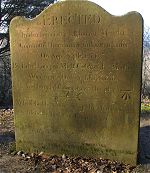
The Sailor's Stone was erected by James Stillwell of nearby Cosford Mill
soon after the murder. It was sited on the Old Coaching Road from London
to Portsmouth close to the site of the murder. The inscription on the front
of the stone reads:
ERECTED
In detestation of a barbarous Murder
Committed here on an unknown Sailor
On Sep, 24th 1786
By Edwd. Lonegon, Mich. Casey & Jas. Marshall
Who were all taken the same day
And hung in Chains near this place
Whoso sheddeth Man's Blood by Man shall his
Blood be shed. Gen Chap 9 Ver 6 |
 |
[NB the following part of the inscription
was clearly added at a later date]
THIS STONE WAS ERECTED
A.D. 1786 BY JAMES STILLWELL ESQRE. OF COSFORD
AND WAS RENOVATED SEP 24TH 1889 BY
JAMES JOHN RUSSELL STILLWELL ESQRE OF KILLINGHURST
THE DESCENDANT AND REPRESENTATIVE OF THE STILLWELLS
OF COSFORD AND MOUSHILL |
The inscription on the back of the stone reads:
THIS STONE
was Erected
by order and at
the cost of
James Stilwell Esqr.
of
Cosford
1786
Cursed be the Man who injureth
or removeth this Stone |
When the London to Portsmouth road was lowered in 1826 the stone was
removed and placed alongside the Punch Bowl bend. It was then removed back
to its original location (and the curse on the back of the stone added).
The stone was then returned down to the Punch Bowl road. Finally the stone
was moved again in 1932 back to its original location when the main road
was widened.
Iona Cross
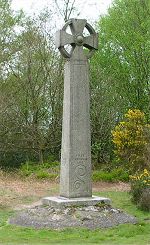
In 1851 Sir William Erle paid for the erection of a granite Iona Cross
on Gibbet Hill on the site of the scaffold. He did this to dispel the fears
and superstitions of local people and to raise their spirits.
The cross has four Latin inscriptions around its base. They read:
POST TENEBRAS LUX
IN OBITU PAX
IN LUCE SPES
POST OBITUM SALUS
- Which translate to
- Light after darkness.
Peace in
passing away.
Hope in light.
Salvation after death.
|
 |
References in art and literature
Gilbert White
Gilbert White of Selborne records, in his
Naturalist's Journal 1768-1793, that on December 23, 1790 there was a terrible
thunderstorm during which:
Two men were struck dead in a wind-mill near Rooks-hill on the Sussex
downs: & on Hind-head one of the bodies on the gibbet was beaten down
to the ground
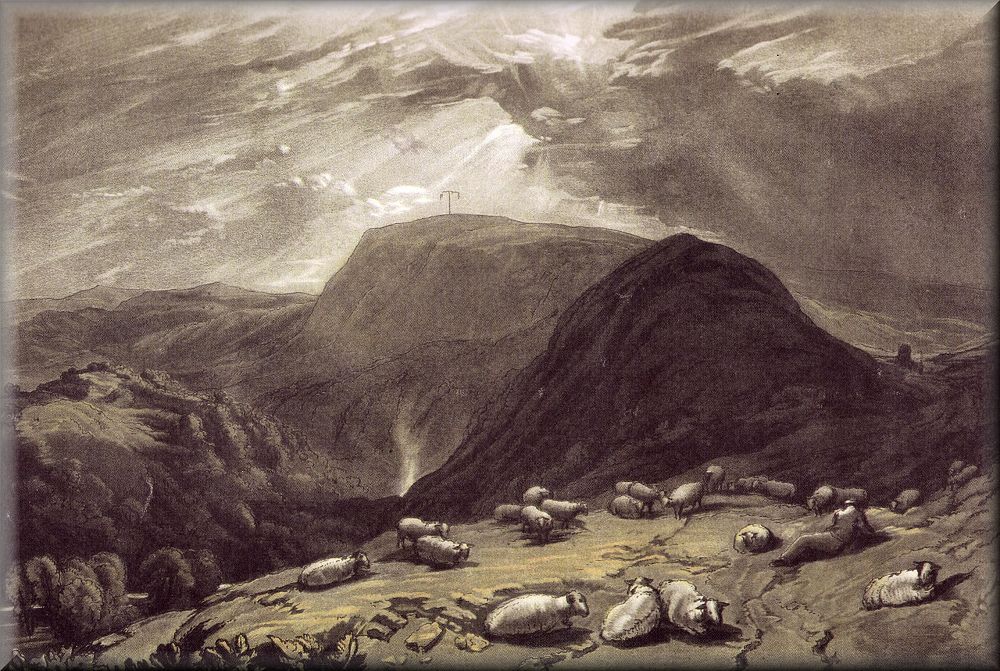
Turner's Liber Studiorum
Between 1807 and
1809 the painter Turner created a collection of 71 Mezzotints under the
title Liber Studiorum. These were published in 1811. One of these (number
25) was of Hindhead Hill with the gibbet clearly shown:
Click on painting to see an enlargement
On his return to London from Spithead in the winter of 1807 Turner was
stimulated by the grisly associations of the place to compose some fragmentary
verses, and when he made his preliminary drawing for his Liber plate he
carefully delineated the forms of the three bodies on the gallows in allusion
to the events of 1787. He reworked the outline of the gibbet in drypoint...
so that it resembles a serif letter 'T'. Turner enjoyed visual punning and
he may have intended the form to represent a macabre allusion to his own
initial.
The verses include the lines "Hind head thou cloud capt hill"
and "Hark the kreaking Irons. Hark the screaching owl"
Nicholas Nickleby
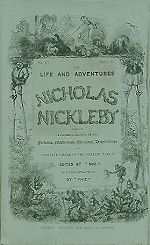
Charles Dickens mentions
the murder of the Unknown Sailor in Chapter 22 of his novel Nicholas Nickleby
published in 1838-9:
They [Nicholas Nickleby and Smike] walked upon the rim of the Devil's
Punch Bowl; and Smike listened with greedy interest as Nicholas read the
inscription upon the stone which, reared upon that wild spot, tells of a
murder committed there by night. The grass on which they stood, had once
been dyed with gore; and the blood of the murdered man had run down, drop
by drop, into the hollow which gives the place its name. 'The Devil's Bowl,'
thought Nicholas, as he looked into the void, 'never held fitter liquor
than that!'
Click here to read full novel as a webpage |
 |
The Broom-squire
In the early nineteenth century the Devil's Punch Bowl became inhabited by several families who enclosed for themselves portions of the western slopes of the Bowl. Here they pastured their sheep, goats and cattle, and added to their earnings the profits of a trade they monopolised: that of making and selling brooms. Rods supplied by coppices of Spanish chestnut served for handles, the long and wiry heather twigs for brush. They became known as the Broom-squires and were a fiercely independent folk. The chief Broom-squire families were the Boxalls, the Snellings and the Nashes. In 1896 the Reverend Sabine Baring-Gould published his novel The Broom-Squire which tells the fictitious tragic story of Mehetabel, supposedly the daughter of the Unknown Sailor, and of her ill-treatment at the hands of Bideabout, one of the Broom-squires.
Click here to read full book as a webpage
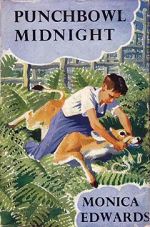
Punchbowl Midnight
The 1951 children's novel Punchbowl Midnight by Monica Edwards features the story of the Unknown Sailor and the Sailor's Stone. One of the characters, Tamzin Grey, believes that she has been cursed because she scratched her initials on the stone with a penknife.
"It was for his money they did it, of course," Lindsey said. "And
there's a curse, you know."
"What sort of curse?"
"Someone put a stone where the crime was committed and it says on it,
'Cursed be the man who injureth or moveth this stone.'"...
"Lindsey, are you sure it says 'injureth' as well as 'moveth'?"
"Of course. Why?"
"Well, it's a pretty slender outlook for me, then. I found the stone
two days ago and I scratched my initials on it with the marline spike of
my knife. Funny thing, I didn't notice any curse at all."
"It's on the back of the stone," said Lindsey. |
 |
- THE END
*******
 
 Return to Book Library Return to Book Library
|