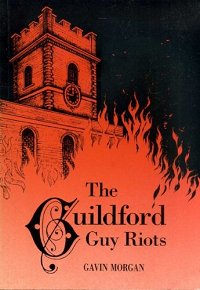
Every November 5, between 1820 and 1865, Guildford shopkeepers closed their businesses early, barricaded their shop fronts and prepared buckets of water to put out fires. The rioters, who called themselves the "Guys", gathered outside the town early in the morning, wearing outlandish costumes and masks. Carrying clubs studded with hobnails, lighted torches and bundles of wood, they then marched into Guildford like an invading army. A witness described their chilling "cry": Their cry will never be forgotten by anyone who ever heard it. It was a thrilling, piercing note of peculiar intensity, and was a warning for all peaceable citizens to be on their guard.[1] For the rioters, Bonfire Night was an opportunity to avenge themselves against fellow citizens who had offended them in any way. Opposite Holy Trinity Church, the Guys built a huge bonfire, piling up gates, railings and doors ripped from the houses of their enemies. Writing in 1912, the folklorist Charlotte Burn described a typical Bonfire Night: Fireworks were let off; the rioters danced round the fire, and went up and down the street, insulting those they met, breaking windows, and doing other damage. It is known that many otherwise peaceable citizens took part in the riots, and more than once a disguised rioter found to his horror that some of the woodwork he was helping to destroy came from his own premises.[2] Suppressing the rioters: Magistrates made repeated attempts to suppress the Guys and in 1843 two ringleaders were fined, their payments raised by public subscription and they were led from prison by a cheering crowd. In the 1850s, when the police tried to prevent rioting, the Guys blew horns to summon reinforcements. The year 1863 saw two riots, when the Guys took to the streets not just on Bonfire Night but also on March 10, to celebrate the Prince of Wales's wedding day. On Bonfire Night, the Guys attacked a local magistrate's house, and demolished the whole front wall with hammers and axes. Yet Guildford was becoming increasingly prosperous, and the growing numbers of middle class townsfolk had little sympathy with rioters. In 1863, they elected a new Mayor, P W Jacob, who had promised to break the power of the Guys. Jacob brought in more police to confront the rioters. This led to increased rioting, with the first fatality coming in 1864, when a police constable died of his wounds during Bonfire Night. An even bigger riot took place in 1865, when another policeman was almost killed. Jacob's response was to arm the police with cutlasses, and send for a detachment of Lancers, who cleared the streets. This was the last serious riot. When the Guys tried to retake the town, in 1866 and 1868, they were quickly dispersed by cavalry. By 1870, according to a report, there was "scarcely a squib" in the whole of Guildford. A further view of events came from Charlotte Burn.[3] The Guys were often joined by normally otherwise peaceful, Guildford citizens, who often found to their horror that some of the woodwork they were helping to destroy, came from their own premises! The rioters called themselves "Guys", and caused absolute chaos in the town, ransacking buildings, letting off fireworks, insulting anyone they came across and burning their "spoils" on the bonfire. Rioters wore masks. In 1854, the wooden racecourse grandstand on Merrow Downs was pulled down and burned outside the church. The rioters were fearless and even attacked the magistrate's house! 1863, 3 October: The Times: A letter to The Times regarding the Guildford: Riots from "Once a Special ... insist upon means for putting down with a strong hand these disgraceful riots and inflicting heavy punishment on the savages concerned." 1863: Guildford Riots: There were two riots the first on March 10 the Prince of Wales' wedding day and the other on the 5 November the usual day for a riot. County officers assisted the Borough i.e. one superintendent one sergeant and seven constables.[4] The mayor called on military support.[5] 1863, 6 November: The Times: Guy Fawkes Day at Guildford: (A report on the 5th before the events of the day) Steps had been taken to prevent the previous years rioting but the "Guys" had resolved not to be deprived of their accustomed bonfire and procession. The mayor had arranged for: fifty Dragoons who came by road and one hundred and fifty men who came by special train from Aldershot, and then marched to their quarters in various public houses in the town. Upwards of one hundred and fifty special constables and two local corps of the Rifle Volunteers the 13th and 24th were ordered to be ready to assist the public peace. The County Constabulary under Superintendent Parr and Mr Inspector Barker have had supplementary forces to prevent any outbreak beyond the jurisdiction of the borough authorities. Today the town is in a state of great excitement. 1863, 29 December: The Times: Guy Riots: PC William Sutton of the Guildford Borough Police standing at Tunsgate close to the police station entrance was approached by three or four men in disguise who knocked him down. He got up and endeavoured to defend himself with his staff but was knocked down again and struck on the body and head."I heard one of the men say 'Murder the ... '. I then became insensible and remember no more." PC James Marshall found three bludgeons, formidable weapons, spokes from a cartwheel weighted at one end. 1864: Guildford Riots: An officer from Guildford Borough was so badly injured he died. County officers assisted the Borough. Graham Hardy: I have found pages 176-179 on the Guildford Guy Riots which mentions two incidents involving attacks on the police, one resulting in four charged with attempted murder after an officer was severely cudgelled in Guildford.[6] 1865: Guildford Riots: PC Stent was attacked and seriously hurt - four men sent for trial. County officers assisted the Borough. This was the last serious disturbance/riot. 1865, 26 December: The Times January 6 1866: Guildford Police Court: PC Stent was on duty at 8.20 pm on the bridge at the lower end of the town when PC Castleman corroborated PC Stent's evidence. PC Watts attended and faced the Guys with other constables. One of the Guys hit him with a heavy blow with a pole and he struck the Guy with his cutlass. A second man rushed at him and his disguise came off. PC Marshall took part in the fight and was attacked by Reeves. Acting Sergeant John Titley and PC Daves with other officers formed a line across the street and encountered the Guys when a shower of stones was flying. Daves was attacked by a Guy with a long pole but he knocked it out of his hand and the Guy fled. Four prisoners were committed for trial at the next assizes. 1868: Guildford Riots: The last of the serious disturbances.
   Return
to Book Library Return
to Book Library
© Copyright by Normandy Historians All Rights Reserved. |