 In 1881, Godalming had electric street lighting and public electricity in people's houses. It was not the first place to have electric street lighting but it was the first place in the world to have public electricity. 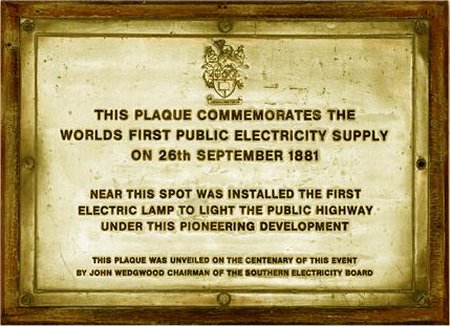 This plaque is on the open ground floor of the Pepperpot and reads: THIS PLAQUE COMMEMORATES THE WORLD'S FIRST PUBLIC ELECTRICITY SUPPLY ON 26TH SEPTEMBER 1881 NEAR THIS SPOT WAS INSTALLED THE FIRST ELECTRIC LAMP TO LIGHT THE PUBLIC HIGHWAY UNDER THIS PIONEERING DEVELOPMENT THIS PLAQUE WAS UNVEILED ON THE CENTENARY OF THIS EVENT BY JOHN WEDGWOOD CHAIRMAN OF THE SOUTHERN ELECTRICITY BOARD On the 3rd September 1881 the Godalming Borough Lighting Committee "had under their consideration the desirability of lighting the Borough by electricity, and with this in view have made arrangements with a London firm of electricians to fix two or three electric lights as an experiment." The Surrey Advertiser of 1st October 1881 (Saturday) reported, "On Monday evening (the 26th September) the upper portion of the Borough of Godalming was lighted by electricity for a few hours as an experiment and continued each night since, the motive power to generate the current being an auxiliary face water-wheel at the Westbrook Mills, of Messrs. Pullman brothers, the skin dressers, who have made arrangements for lighting their mills with the Swan lights[1], and for the larger open spaces with Siemen's differential lamps of 300 candle-power each." The Surrey Advertiser reported the Mayor (Alderman Eager[2]) and members of the council had visited Messrs Pullman's Mills to see the machinery at work." Street Lights 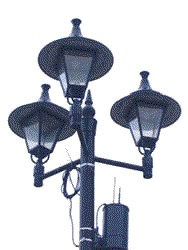 These are the lamps referred to above. They are on the small traffic island where High Street, Wharf Street and Bridge Street meet. News reached as far afield as Bristol where The Bristol Mercury & Daily Post of the 29th September reported the experiment to light part of Godalming by electricity generated by a water wheel. Public Electricity  "Swan" light bulbs 1880s Water Power The power was generated at Westbrook Mill (formerly Salgasson Mill), the tannery owned by R & J Pullman on the River Wey. Water on a side channel turned the two Poncelet waterwheels to drive a Siemens alternate current dynamo machine generator. The French designed Poncelet waterwheel had been in use since 1838 and was twice as efficient as undershot waterwheels. Initially floods presented a problem and back water caused insufficient revolutions of 700 to be made and to overcome this a 10-horse power steam engine had been brought into use made by Messrs Wallis and Steevens, engineers of Basingstoke. A contract had been made between the Town Council and Pullmans tannery that in compensation for the use of their water rights, they would be given lights for the yards, factory buildings and Mr J Pullman's house. Pullmans business included the preparation of chamois, buckskin, and saddle leather and they undertook Government contracts. To have the mills and yards lit day and night for the men to work by was a great advantage and by the 16th December 1881 The Times reported that Pullmans had three arc lights and fifteen Swan lamps lighting the mills. The Times reported that in Godalming, branching off from seven arc lights (three in the town) were overhead bare copper wires attached by insulators to poles for 40 Swan incandescent lights which burnt in the minor streets. The incandescent lights were in pear shaped lanterns which had been placed into the ordinary gas lamps. The arc lights were enclosed in square lanterns of clear glass and gave out more light than the Swan lights. It involved two circuits and in total covered about 5 miles. In Engineering of the 13th January 1882 it was stated that Pullmans had three arc lights and seven incandescent lights and the town had four arc lights and 27 incandescent lights. The arc lights gave at least 300 candle-power whilst the Swan lights gave about 30 candle-power. Gas In January 1882 Siemens agreed to light the town by transferring the generating plant from Pullmans mill to the town and laid the main cables in the gutters. George Stephen Tanner (1868-1954) recorded his reminiscences and wrote "When the floods came it upset in some way the water power and so the dynamos were taken to a shed at the back of the old White Hart and an ordinary traction engine used with a wide strap on its wheel to connect to the dynamo. There was a very nice German (Edward Friedrich Herman Henrich Lauckert) here to look after the technical side". On the 18th August 1882 a new Electric Lighting Act was introduced giving powers to break up the streets to lay cables. Siemens continued their annual contract to operate without laying cables in gutters until 1884. Alexander Siemens reviewed the private sales when he had about a dozen consumers with 160 lamps but needed 400-500 private lights to make it economic and according to the Electrician in April 1884 "was not prepared to tender on a year-to-year basis to gain experience…. except on a legal footing". The electricity supply proved too expensive and the local gas company tendered a cheaper cost to light the town. Gas returned as the source of lighting on the 1st May 1884. On the 4th February 1902 the Town Council was in communication with the Urban Electric Supply Company (which had opened in Borough Road in 1902) who had submitted a tender. They offered to fit incandescent electric lamps holding 25 candle-power and to maintain the 236 lamps in the Borough for £649 per annum, burning from half-an-hour after sunset to 12 o'clock at night at a rate of £2 15s per 25 candle-power lamp. Lighting per half night by gas was £893, while electricity at 25 candle-power was £649. The present contract with the Gas Company was until 1st January 1903 and until then the number of lamps lighted by gas was to be reduced to 150. The committee recommended that 86 of the public lights be lighted by electricity as soon as possible and that the Borough be lighted with lamps giving a minimum light of 25 candle-power, and the agreement with the Godalming Gas Company be terminated as from 1st January 1903. On the 6th May 1902 there were visits to Sandown, Shanklin and Ventnor on the Isle of Wight to inspect their lighting. A scheme was accepted with 10 arc lamps of 750 candle-power each, 105 incandescent lamps of 50 candle-power each and 109 incandescent lamps of 25 candle-power each, to light the area at present served by 236 gas lamps. This came to a final cost of £793 15s 0d, just under £100 less than the gas price tendered. Electricity returned as the source of lighting in 1903. In 1902 the Urban Electric Supply Company Ltd opened its works in the Borough Road and advertised ‘mains laid in practically every road in the Borough'. So it would appear that the public had to wait for eighteen years after the first experiment before getting access to electricity again. Notes
   Return to Book Library Return to Book Library
|